There will be some heavy lifting here. Don't be discouraged if it's confusing. Especially if this is your first time being introduced to quantum mechanics. It's very strange and even Nobel prize winners like Richard Feynman didn't fully understand it.
Let's set up an electron gun that shoots one electron at a time towards a barrier that has two slits in it. It shoots one at a time over a long period of time, say 24 hours. It shoots one at a time so that we have no concerns about the electrons electrically repelling one another while they travel. This will simplify the discussion. The slit separation must be very small, ~10⁻¹⁰ meters. If you're interested in where this number comes from, you can do a search for the de Broglie wavelength (λ = h/(mv)). The slit separation must be close to the de Broglie wavelength. For our purposes, the statement of this condition is sufficient.
If we believe that electrons are pointlike particles, then they should behave like bullets. There should be two bands of arrivals on the photographic film backdrop, one band for each slit in the barrier. But when we run the experiment, we get something different. We get many bands. Very strange.
ψgun ⇒ ψ1 + ψ2 ⇒ |ψ1 + ψ2|²
ψgun = wave function emitted by the electron gun
ψ1 = wave function due to slit 1 diffraction
ψ2 = wave function due to slit 2 diffraction
|ψ1 + ψ2|² = probability function for the electron's arrival
Apparently, the electron doesn't behave like a bullet. Rather, it behaves like a traveling wave function. That is, when you don't look at which hole the electron went through, the electron propagates as a wave function of existence, diffracts through the two slits, produces two new wave functions (that are both associated with the same electron), they interfere with each other, and produce a wave-like interference pattern of arrival on the photographic film backdrop. Read the last sentence slowly, a few times over if you need. Saying it out loud helps.
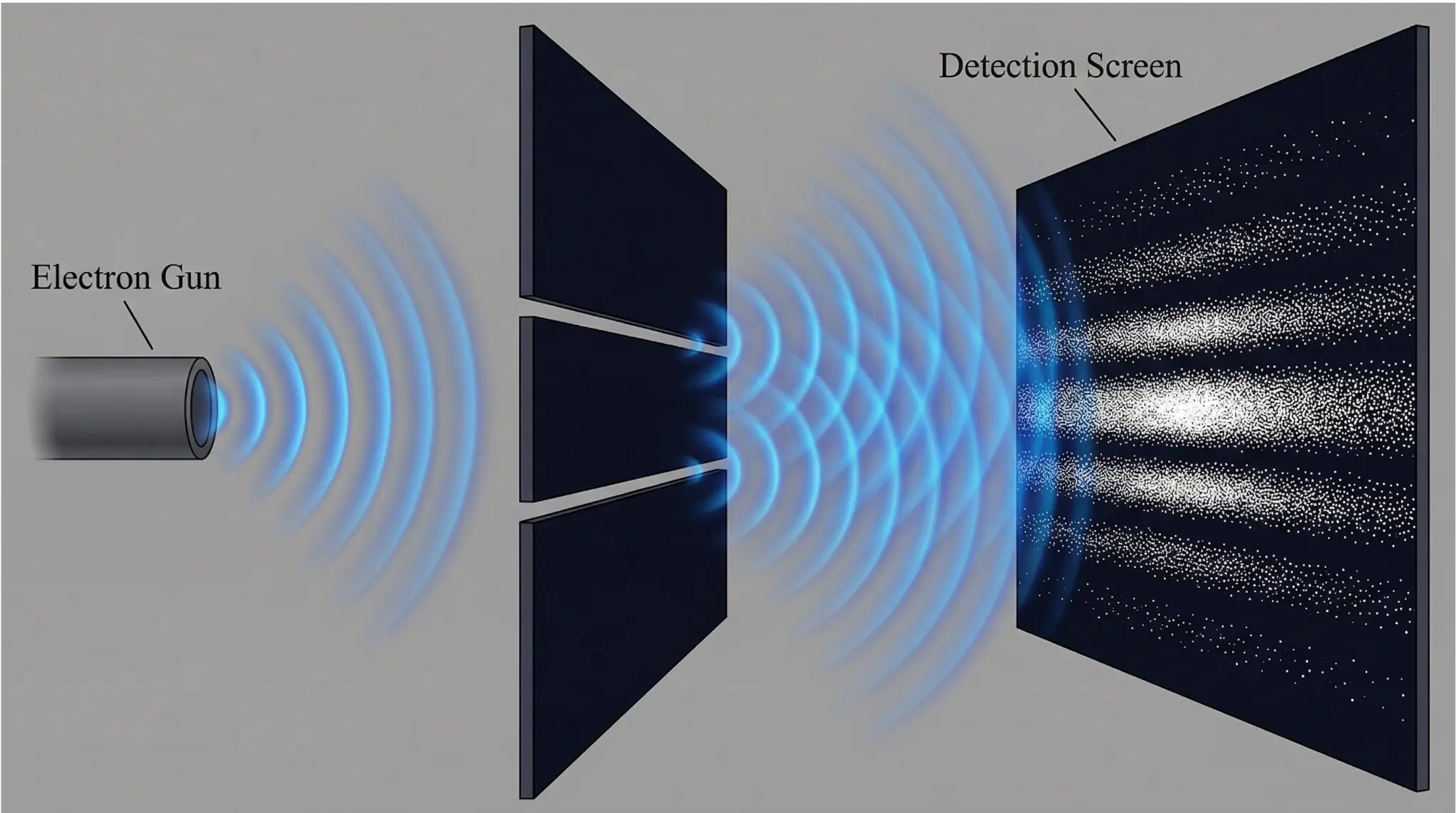
Welcome to the bizarre world of quantum mechanics.
You can consider the photographic film to be the place where the measurement is finally made, thus collapsing the wave function to a location. We say that the wave function travels from the electron gun, diffracts through the two slits, interferes with itself as it travels towards the photographic film, and then the wave function interference pattern collapses at the photographic film. Forcing the electron to take a stand and be somewhere. The wave function is a mathematical construct useful for predicting the outcome of this experiment. It can be found by solving the Schrödinger equation.
Echoes are good: All of nature appears to be designed. And a design must have a Designer.
Keep in mind that the original wave function that is emitted by the electron gun gives rise to two new wave functions: ψgun ⇒ ψ1 + ψ2. It is ψ1 and ψ2 (both associated with the same electron) that interfere with one another. That resulting wave function {ψ₁ + ψ₂} is what arrives at the photographic film. Then, in order to compute the probability of an electron arriving in a particular location, the probability amplitude of this must be computed. This is done by taking the complex conjugate of a wave function and then multiplying it by the original wave function. This probability amplitude is then integrated over a spatial interval to find the probability of an electron arriving in that spatial interval, at time t.
P(x) = ∫ |ψ1 + ψ2|² dx = ∫ (ψ1 + ψ2)*(ψ1 + ψ2) dx
Integrated from a to b, gives the probability that an electron will arrive between a and b.
There's no way around the mathematical complexity of quantum mechanics. Each electron arrives at a single location. But over time, after many thousands of electrons are fired at the double slitted barrier, we end up with the interference pattern of electrons.
Now let's change something about the experiment. Let's now look and see which hole each electron goes through as the experiment is run. This measurement is made at the barrier with a device so that we can determine which slit a given electron goes through. We should see the same bizarre behavior right? Wrong. We see two bands now.
In this scenario, the wave function of the electron travels as a probability wave on the left side of the barrier, then is observed at the double slitted barrier, thus collapsing the wave function, forcing the electron to take a stand and be somewhere, either at slit 1 or slit 2, long before it gets to the photographic film detection screen. In a sense, the electron becomes a bullet-like particle again when it passes the barrier. Passing through one slit or the other. Not both at the same time, as with wave functions (not looking).
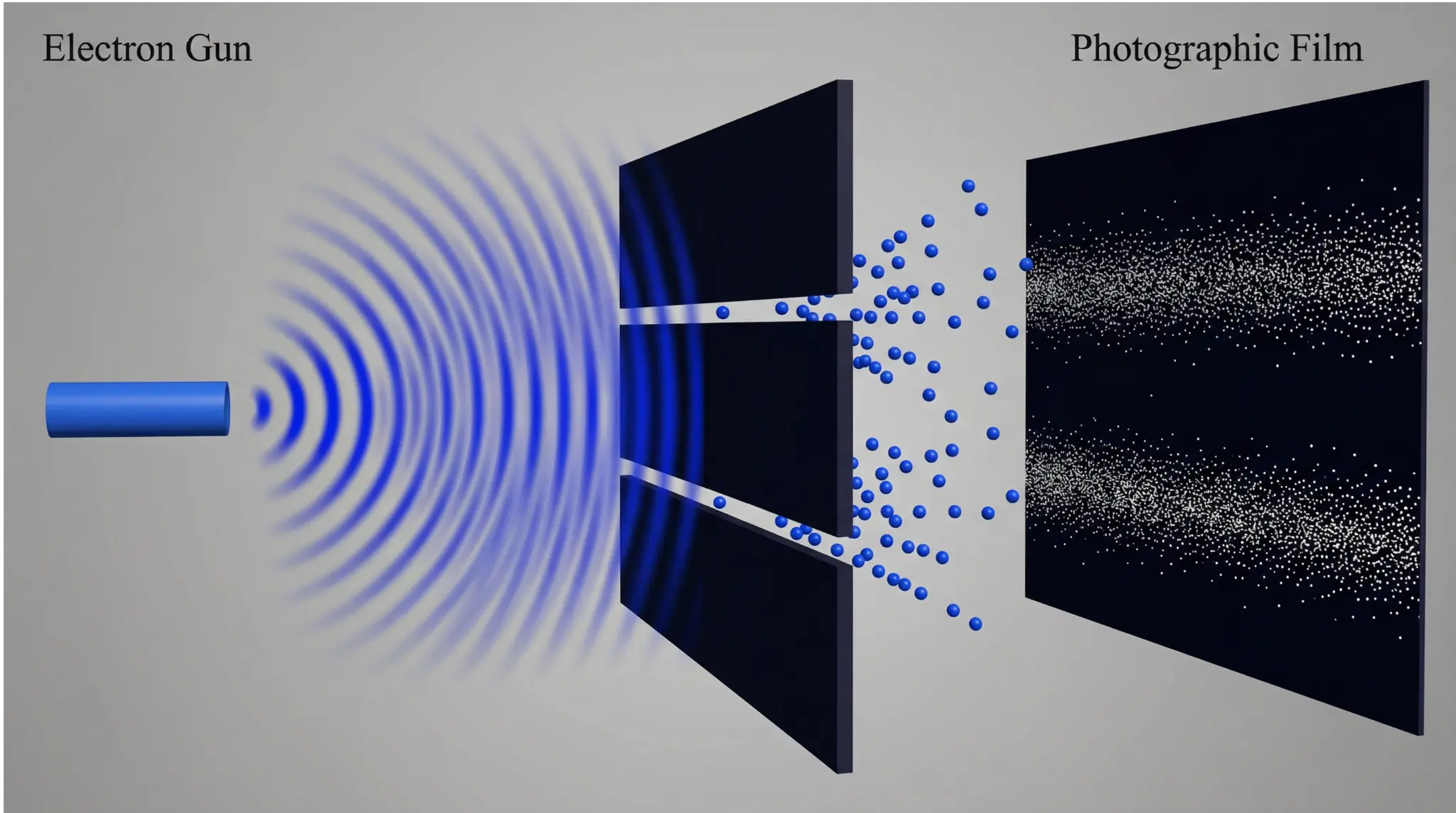
In summary, electrons behave like waves when you don't look at them. And they behave like bullets when you do. While he was alive, Richard Feynman was one of the foremost authorities on this subject.
"And no one has figured a way out of this puzzle. So at the present time we must limit ourselves to computing probabilities. We say 'at the present time,' but we suspect very strongly that it is something that will be with us forever—that it is impossible to beat that puzzle—that this is the way nature really is."
Here's the payoff. To understand quantum mechanics, you will never solve the puzzle. You have to accept the mystery of the puzzle for what it is. Appreciating the beauty of the mystery is the goal. Sound familiar? Quantum mechanics mirrors the mysteries in our Catholic faith.
Jesus is an excellent example. When the Church was first formed, there was a debate: Was Jesus a man or was he God? Answer: He's both. The Catholic Church formally defined the dual nature of Jesus, fully God and fully man, in the year 451 AD at the Council of Chalcedon. Electrons have a dual nature: waves and particles. Is an electron a wave or is it a particle? It's both. Was Jesus a man or was he God? He's both. It's my view that the dual nature of particles points us towards the dual nature of Jesus.
There are other dualities that are interesting to consider. The antichrist for example. Who is the antichrist? John tells us that anyone who doesn't accept Jesus is an antichrist. Don't be alarmed if you think, "Hey wait a minute, am I the antichrist?" No. You're not 'The Antichrist.' You're one among many according to John. It's not a big deal. You can still accept Jesus and change that. When you do, you will become like us, a Christian.
So when someone asks you, "Are you an antichrist or a Christian?" You can say, "Both! I was an antichrist but now I believe and have become like Christ. It depends on when you observed me." Again, the duality shows up here.
Who is the liar? Whoever denies that Jesus is the Christ. Whoever denies the Father and the Son, this is the antichrist.
If you think about it, we are all born as antichrists. Because none of us believe in Jesus when we are born. We come into that over time. Food for thought. Don't fret. The end times will likely be a conversion story for the planet. Not doom and gloom as so many people are blood lusting for. Every man, deep in his heart, is longing for the world to end. I just think it's better for us to embrace the world ending in a peaceful way. Worldliness ends. Not the world itself. More sacrificial servants will rise up to do the work of making the world a better place.
Quantum mechanics says that when particles aren't being observed, their wave functions spread out over space (as time progresses), so that particles can't be determined to be at any one location. But rather, particles have a probability of being found at different locations. Your thoughts cannot be calculated because of this spreading in your brain. Quantum mechanics is the mechanism of free will and God's interaction with you. God speaks to you through these wave functions. Through the uncertainties He created. To guide you Home.
I have heard some humans online proclaiming that free will is an illusion. I was shocked when I saw men who I admired promulgating such nonsense. Of course we have free will. Quantum mechanics proclaims it.
We are all just thinly veiled wave functions. Especially our brains. Think about it. Really, take some time. Meditate on it even. You can only observe the surface of objects with your eyes. If you have faith in quantum mechanics, and hopefully by now you do, the rest is wave functions. What is underneath the surface of the objects you are looking at right now? Is it simply just more matter? Or is it wave functions? It's wave functions man!
For the scientifically initiated, there is the issue of quantum decoherence here. I mention it so that you can delve deeper into this topic on your own if you would like to. I actually might be wrong about this. By all means, prove it. I look forward to a spirited debate with you about this.
Logical awakenings are rare. But they are usually enough to say, "Maybe?" If these arguments did that for you, I would encourage you to go to any Catholic Church and sit in front of an icon of Christ crucified. Gaze upon Him while there. If you're going through a rough time right now, ask God the same question Jesus asked on the cross, "Why have you forsaken me?" Trust me, Jesus can relate. What is He trying to show the world through you?
One last thing about your conversion. People don't fall in love with arguments. They fall in love with people. Arguments are just a vehicle for a connection with another soul, which will fuel you. If you're serious about changing your life, I would suggest seeking out a practicing Catholic. Argue with him or her. Bring your objections to the table. We have answers. We've been doing this for a long time. Godspeed.